Roadmap to Debt freedom
Feeling overwhelmed by debt is a common experience, but it doesn't have to be a permanent one. The journey to financial freedom can feel daunting, but it becomes achievable when broken down into manageable steps. This email is your roadmap, a clear, four-phase action plan that will guide you from understanding your debt to actively eliminating it. Let's take the first step together.
------------------------------------------------------------------------------------
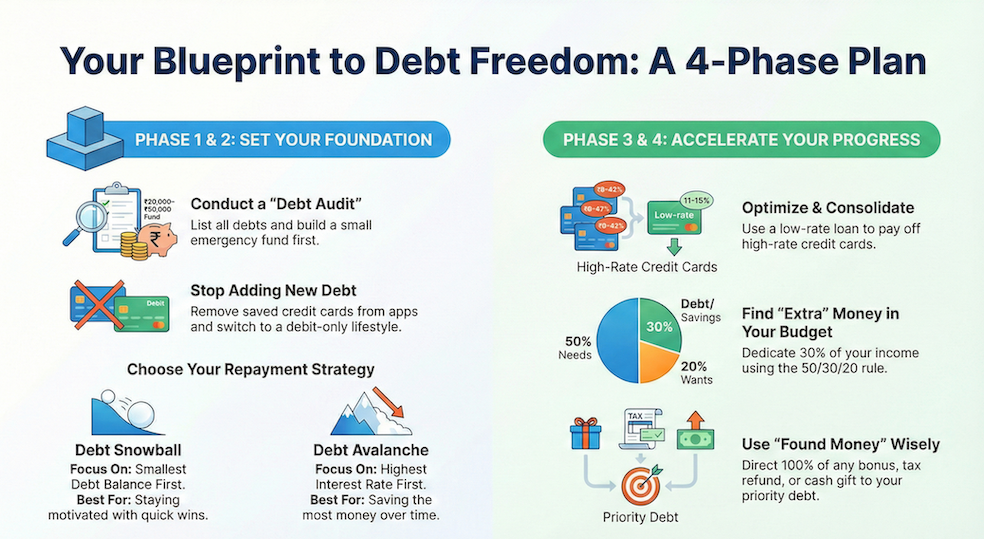
Phase 1: Build Your Foundation (The Debt Audit)
Before you can start paying down debt effectively, you need to understand the full picture and prepare for the journey ahead. This phase is about gaining clarity and creating the stability needed for long-term success.
1. List Every Debt The first step to gaining control is to know exactly what you're facing. Create a comprehensive list of every single loan and credit card balance you have. This exercise removes uncertainty and transforms a vague sense of worry into a concrete list you can manage.
2. Establish a Safety Net It may seem counterintuitive, but before aggressively paying down debt, you must set up a small emergency fund of ₹20,000–₹50,000. This isn't a delay; it's essential insurance. When an unexpected expense like a car repair or medical bill arises, this fund will prevent you from having to take on new debt, ensuring your progress isn't derailed.
3. Stop the Bleeding You cannot get out of a hole while you are still digging. Make a firm commitment to not adding any new debt to your name while you are in repayment mode. Two immediate actions can help enforce this rule:
- Delete all saved credit card information from online shopping sites and apps.
- Switch to a debit-card-only lifestyle for your daily spending.
Phase 2: Choose Your Repayment Strategy
There are two proven methods for tackling multiple debts. The "best" one is not about complicated math; it's about choosing the strategy that best fits your psychology and keeps you motivated for the long haul.
1. Debt Snowball (For Motivation)
How It Works: Pay the minimum amount on all of your debts. Then, direct every extra rupee you have toward the debt with the smallest total balance first, regardless of its interest rate.
Primary Benefit: You get a quick psychological win when your first, smallest debt is paid off. This builds momentum and motivation, making you more likely to stick with the plan.
2. Debt Avalanche (For Math)
How It Works: Pay the minimum amount on all of your debts. Then, direct every extra rupee you have toward the debt with the highest interest rate first, regardless of its balance.
Primary Benefit: You pay the least amount of total interest over the life of your loans. This method saves you the most money in the long run.
There is no wrong answer here. The most effective plan is the one you will consistently follow. Choose the strategy that you believe will keep you the most engaged and motivated. Once you have selected a strategy and put it into motion, you can explore ways to make your payments work even harder for you.
Phase 3: Accelerate Your Progress (Lower Your Interest & Pay Less)
With your repayment plan active, the next step is to find ways to reduce the amount of interest you're paying. Lowering your interest costs means more of your money goes directly toward paying down the principal balance, speeding up your journey significantly.
1. Debt Consolidation If you are juggling multiple high-interest debts, such as credit cards with rates of 36-42%, debt consolidation can be a powerful tool. The goal is to take out a single personal loan at a much lower interest rate (e.g., 11-15%) and use it to pay off all your other debts at once. This simplifies your finances into one monthly payment and can save you a substantial amount of money on interest
2. Loan Against Mutual Funds (LAMF) If you can pay off credit card debt using loan amount collateralized to your mutual fund scheme, it is a sophisticated debt optimization strategy. It leverages your existing assets to swap high-interest debt (typically 36%–45% APR) for a low-interest secured LAMF loan (typically 9%–12% APR). The benefit is your investments remain in the market, continuing to earn compound interest and dividends while acting as collateral.
3. Balance Transfer This is a tactic for tackling high-interest credit card debt. Look for credit cards that offer a 0% introductory interest rate on balance transfers for a promotional period, often 6-12 months. By moving your high-interest balance to this new card, you get a temporary "grace period" where interest stops accumulating. During this time, every rupee you pay goes directly to reducing the principal. Be aware: This is a temporary strategy. Have a plan to pay off the balance before the promotional period ends, as the interest rate will typically jump to a very high level afterward.
4. Bank Negotiation If you are genuinely struggling and have a history of consistent payments, being proactive with your bank can open up options. Call your bank's recovery or hardship department and explain your situation. Based on your repayment history, you can ask for one of two outcomes:
- Interest Rate Reduction: A permanent or temporary lowering of your interest rate.
- Moratorium: A temporary pause on payments to give you time to get back on your feet.
Phase 4: Find the Cash to Fuel Your Plan
A debt repayment strategy requires fuel, and that fuel is extra cash. By making intentional adjustments to your finances, you can free up more money to direct toward your priority debt each month.
1. Adjust Your Budget: The 50/30/20 rule is a popular budgeting framework. To supercharge your debt repayment, consider adjusting it temporarily. Aim to allocate 50% of your income to needs (housing, food), 20% to wants (entertainment), and a powerful 30% toward debt & savings.
2. Use "Found Money." Wisely: Create a simple rule for any unexpected income you receive. 100% of "found money"—like a work bonus, a tax refund, or a cash gift—should be immediately directed toward your priority debt according to the Snowball or Avalanche method you chose.
3. Generate Micro-Earnings: The modern gig economy offers flexible ways to earn extra income. Consider these options and commit the earnings solely to your debt repayment plan:
- Sell unused items (clothes, electronics, furniture) on re-commerce platforms.
- Take on 2-3 hours of freelance work per week in a field you're skilled in.
-------------------------------------------------------------------------------------
Get aware of your options and build a strong foundation! Learn more today.
For Youtube: Click here!
For Linkedin: Click here!
For Instagram: Click here!
For any further details contact Finkasturi Nivesh at https://www.finkasturi.com/contact-us
Disclaimer & disclosures: https://www.finkasturi.com/disclosures