Monthly market commentary, knowledge series and more from FinKasturi Nivesh. 15 posts in 2026.
The Month That Was: September 2026
· Category: Global Markets
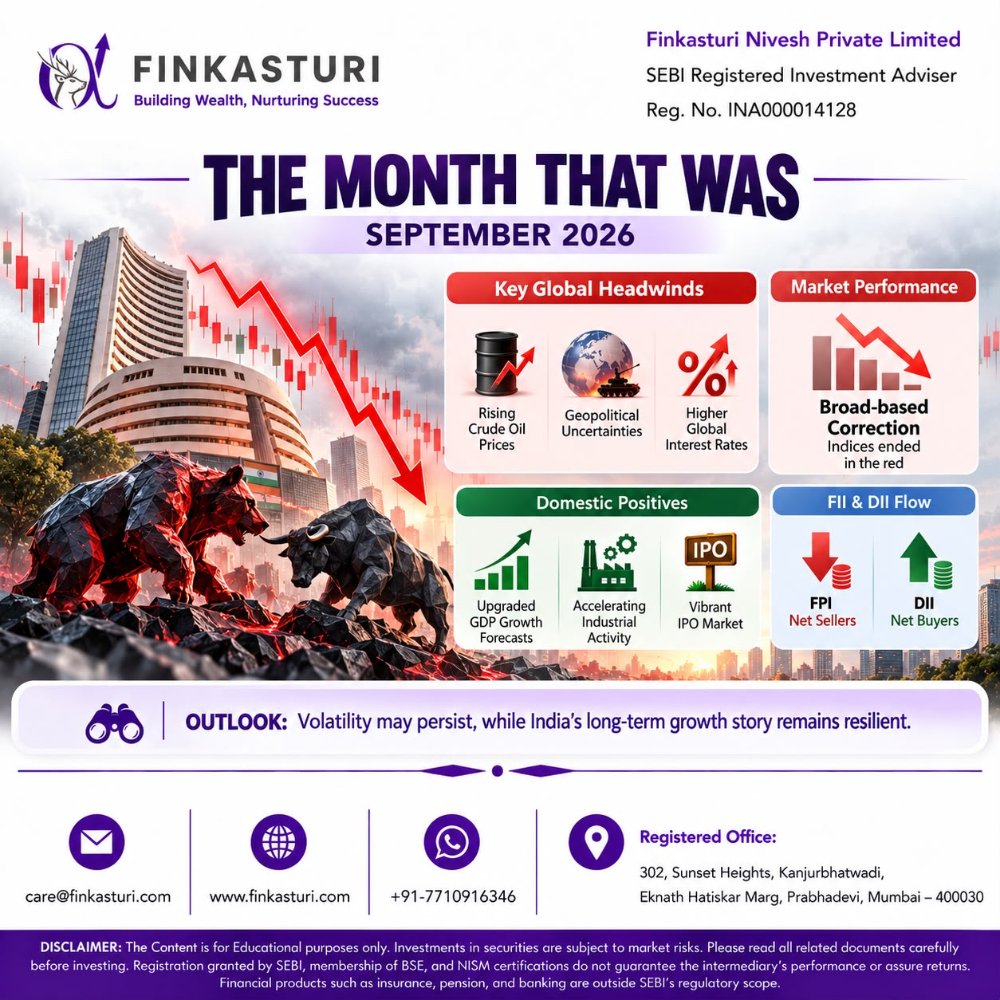
Indian equities faced a broad-based correction in September, with major benchmarks closing firmly in the red. Unlike the previous month's resilience, the selling pressure was felt across the board, weighing on large-cap, mid-cap, and small-cap segments alike. Sectorally, it was a challenging period as all major indices ended in negative territory, with the technology, auto, and real estate sectors getting most impacted. On the global stage, India lagged most of the international and regional peers in terms of equity market performance.
The market's mood was predominantly dampened by a mix of global headwinds. Rising crude oil prices, persistent geopolitical uncertainties, and the overarching pressure of elevated global interest rates—driven by synchronized rate hikes from major central banks—kept investors on the edge. However, the domestic narrative offered several silver linings. Global agencies expressed strong confidence in India's long-term trajectory by upgrading GDP growth forecasts, and international trade tensions showed signs of a temporary thaw. On the ground, while retail and wholesale inflation ticked up slightly and the country navigated a subpar monsoon season, industrial production showed highly encouraging signs of acceleration.
On the liquidity front, foreign portfolio investors turned net sellers in September after two consecutive months of inflow. Domestic institutional investors continued to be net buyers, absorbing the sell-off and providing cushion to the markets.
Market Outlook -
Moving forward, the Indian markets are likely to remain in a push-and-pull dynamic between solid domestic growth prospects and volatile global factors. While tighter global monetary policies and geopolitical frictions will keep near-term sentiment cautious, the underlying strength of the Indian economy—highlighted by upgraded growth forecasts and accelerating industrial activity—offers a highly compelling narrative. The vibrant IPO market and relentless support from domestic investors underline a deep-rooted confidence in the India growth story. For investors with a medium to long-term horizon, these corrective phases often present attractive opportunities to build robust portfolios while the broader economic engine continues to grow.
Investments in securities market are subject to market risks. Read all the related documents carefully before investing. This content is for general information and is not investment advice. Past market movements do not indicate future performance. Please consult your financial advisor.
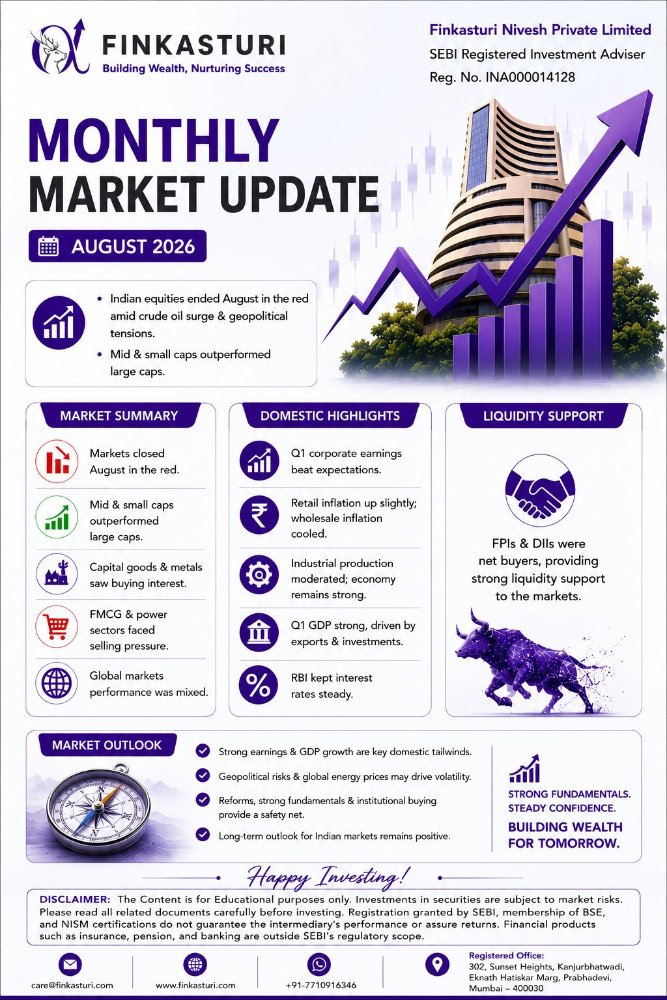
Indian equities remained subdued in August, closing the month in the red as investor sentiment was dampened by surging crude oil prices and resumption of heightened geopolitical frictions. Despite the overarching pressure on large-cap benchmarks, the broader markets displayed notable resilience, with mid-cap and small-cap indices distinctly outperforming their larger peers. At a sectoral level, capital goods and metals attracted steady buying interest, whereas consumer staples (FMCG) and power sectors faced selling pressure. In terms of the global markets, performance was mixed.
The domestic market narrative was shaped by a blend of macroeconomic data, geopolitical tension and a remarkably strong corporate earnings season. First-quarter net income across major indices comfortably beat street estimates, highlighting underlying robust corporate health. On the economy front, while retail inflation edged up slightly, wholesale inflation showed signs of a marginal cooldown. Although industrial production growth moderated compared to the previous month, the broader economic engine remained robust, evidenced by a strong first-quarter GDP print driven primarily by healthy exports and capital investments. Furthermore, policy stability was maintained as the central bank opted to hold key interest rates steady.
The Indian secondary equity markets witnessed robust liquidity support, with both foreign portfolio investors and domestic institutional investors acting as net buyers for the month.
Market Outlook - Moving forward, Indian equity markets are expected to balance the strength of domestic fundamentals against the unpredictable nature of global headwinds. The stellar corporate earnings delivery and strong GDP growth serve as significant domestic tailwinds. However, the ongoing international geopolitical tensions and the trajectory of global energy prices will likely dictate near-term market sentiment. Ongoing government emphasis on reforms on the manufacturing sector, coupled with sustained institutional buying provide a safety net for the markets against external shocks. As the economy continues to be propelled by robust investment and consumption engines, the underlying structure of the Indian market remains highly attractive for investors with a medium to long-term horizon.
Investments in securities market are subject to market risks. Read all the related documents carefully before investing. This content is for general information and is not investment advice. Past market movements do not indicate future performance. Please consult your financial advisor.
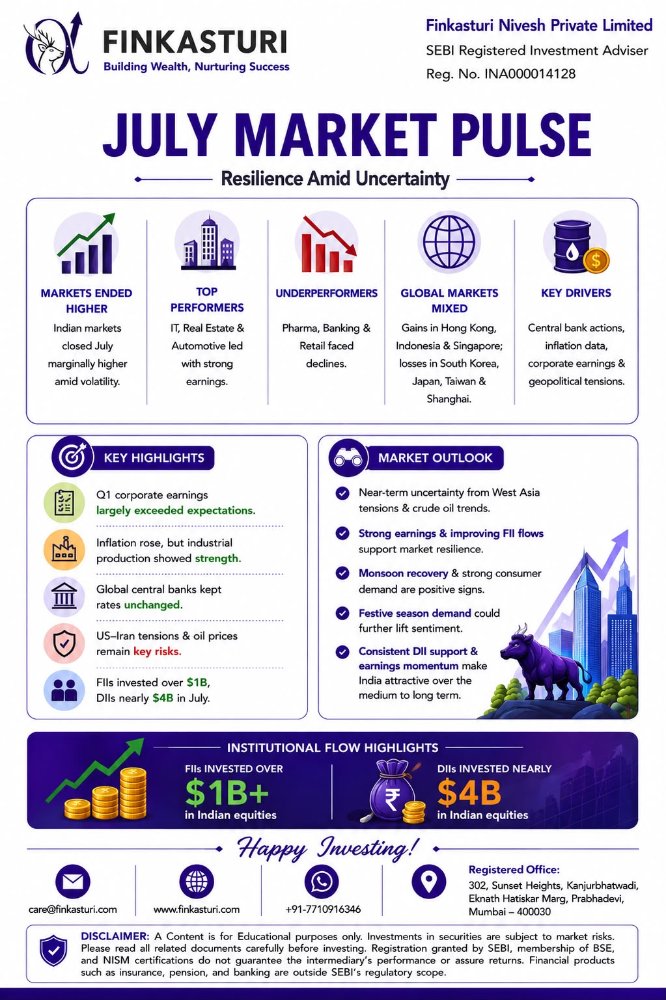
Indian stock markets ended July on a mildly positive note, with the benchmark indices posting modest gains after a volatile month. A major reason for the underlying volatility was renewed geopolitical tensions, which resulted in a significant surge in crude oil prices again, coupled with market reactions to the first-quarter corporate earnings. While the large-cap index witnessed a modest rise during the month, the mid-cap and small-cap indices ended noticeably higher. Companies in the IT, real estate, and automotive sectors had a strong month driven by better-than-expected earnings and improving deal momentum, while the pharmaceutical, banking, and retail sectors faced declines. Globally, the performance of various markets was mixed. Several Asian markets like Hong Kong, Indonesia, and Singapore saw strong gains, while markets in South Korea, Japan, Taiwan, and Shanghai lost ground, largely due to a global semiconductor and AI sell-off.
Market mood was heavily influenced by central bank actions, inflation data, corporate earnings, and shifting geopolitical developments. A key positive takeaway was that quarterly corporate earnings largely exceeded market expectations. On the economy front, both retail and wholesale inflation continued on an uptrend during the month. However, industrial production growth rose strongly, signaling underlying economic resilience. Central banks offered stability, as the US Federal Reserve, Bank of England, Bank of Japan, and the European Central Bank all decided to keep their respective key policy rates unchanged, maintaining stances that were in line with market expectations.
Geopolitically, renewed US-Iran tensions escalated fears and drove energy prices higher, while the US maintained its current tariff structures for India. On the institutional front, both foreign and domestic investors showed confidence in the Indian secondary equity market, with foreign investors pouring in over $1 billion and domestic investors stepping in with massive support, investing nearly $4 billion during July.
Market Outlook - Indian equity markets continue to navigate near-term uncertainty driven by geopolitical conflict in West Asia. While better-than-expected corporate earnings act as a tailwind for Indian markets, cues in terms of escalating geopolitical tensions in the Middle East and the trajectory of crude oil prices are expected to dominate the markets in the near term. Improvement in FII flows in July and recovery in Monsoon have cushioned Indian markets last month and could actually be a balancing factor for negative Global cues. Domestic consumer demand remains strong as witnessed from robust auto sales so far. Market sentiments should improve further if this resilience in consumer demand is carried forward to the upcoming festive season. Amidst near-term volatility, consistent domestic institutional support and positive earnings momentum make Indian markets attractive from a medium to long-term perspective.
Investments in securities market are subject to market risks. Read all the related documents carefully before investing. This content is for general information and is not investment advice. Past market movements do not indicate future performance. Please consult your financial advisor.
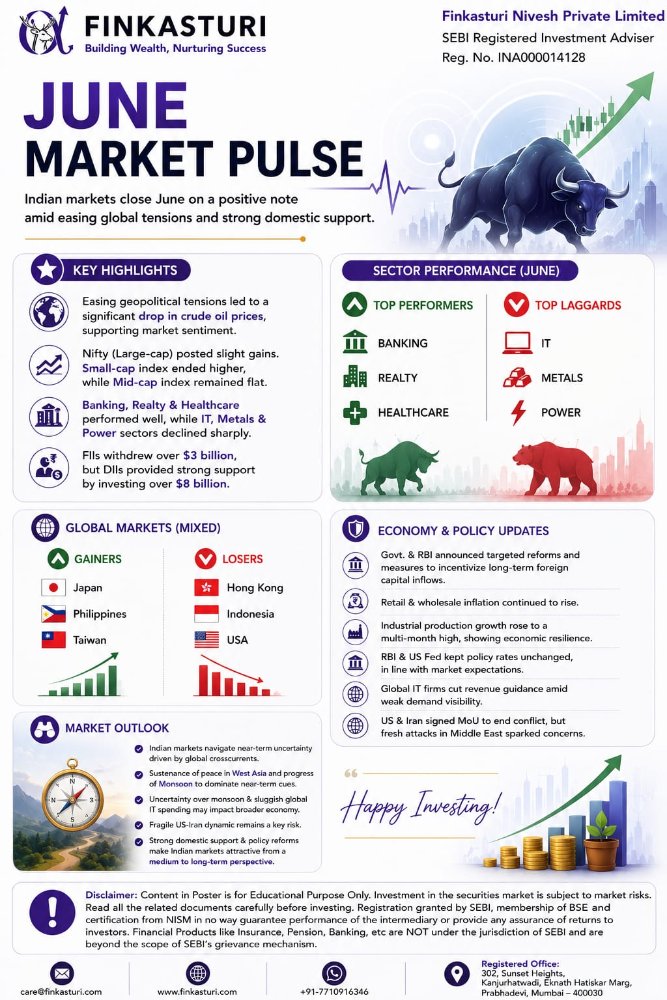
Indian stock markets ended June on a mildly positive note, with the benchmark Nifty index posting slight gains. A major reason for the positive undercurrent was easing geopolitical tensions, which resulted in a significant drop in crude oil prices compared to the previous month. While the large-cap index witnessed a modest rise during the month, the small-cap index ended noticeably higher, whereas the mid-cap index remained largely flat. Companies in the banking, realty, and healthcare sectors had a good month while the IT, metals, and power sectors faced steep declines and dragged the broader market lower. Globally, the performance of various markets was mixed. Several Asian markets like Japan, the Philippines, and Taiwan saw strong gains, while markets in Hong Kong, Indonesia, and the US lost ground.
Market mood was heavily influenced by central bank actions, inflation data, and shifting geopolitical developments. A key positive takeaway was the government and the RBI announcing a series of targeted reforms and measures to incentivize long-term foreign capital inflows. On the economy front, both retail and wholesale inflation continued on an uptrend during the month. However, industrial production growth rose to a multi-month high, signaling underlying economic resilience. Central banks offered stability, as both the RBI and the US Federal Reserve unanimously decided to keep their respective key policy rates unchanged, maintaining stances that were in line with market expectations. Meanwhile, concerns over global tech spending emerged after major international IT firms flagged weak demand visibility and trimmed their revenue guidance. Geopolitically, the US and Iran signed a memorandum of understanding to end their conflict, though fresh attacks in the Middle East quickly revived fears of renewed escalation. While foreign investors pulled out over $3 billion from the Indian secondary equity market during the month, domestic investors stepped in with massive support, pouring in over $8 billion.
Market Outlook - Indian equity markets continue to navigate near-term uncertainty driven by global crosscurrents. While proactive regulatory measures to attract foreign capital and strong industrial production act as tailwinds, cues in terms of sustenance of peace deal in West Asia and progress of Monsoon are expected to dominate in the near term. Over the next few months, uncertainty over monsoon and sluggish global IT spending could impact the broader economy. Global issues, such as the fragile US-Iran dynamic also remain as prominent risks to economic growth and equity market performance. Amidst near-term volatility, robust domestic institutional support and ongoing policy reforms make Indian markets attractive from a medium to long-term perspective.
Investments in securities market are subject to market risks. Read all the related documents carefully before investing. This content is for general information and is not investment advice. Past market movements do not indicate future performance. Please consult your financial advisor.
Content in Poster is for Educational Purpose Only. Investment in the securities market is subject to market risks. Read all the related documents carefully before investing. Registration granted by SEBI, membership of BSE and certification from NISM in no way guarantee performance of the intermediary or provide any assurance of returns to investors. Financial Products like Insurance, Pension, Banking, etc are NOT under the jurisdiction of SEBI and are beyond the scope of SEBI's grievance mechanism.
Investments in securities market are subject to market risks. Read all the related documents carefully before investing. This content is for general information and is not investment advice. Past market movements do not indicate future performance. Please consult your financial advisor.
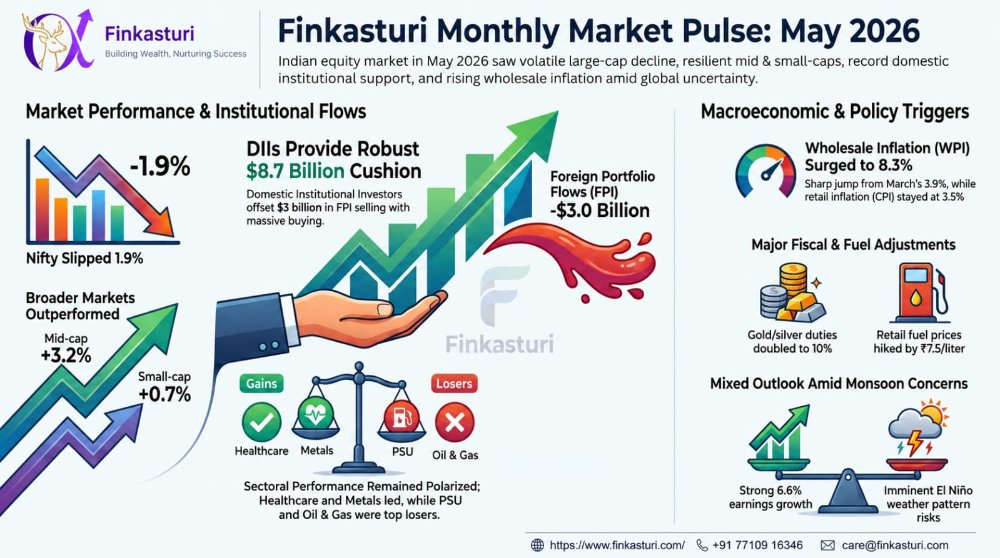
Indian stock markets ended the month slightly lower, with Nifty50 Index dipping by about 1.9%. A major reason for the market fall was global uncertainty, particularly related to ongoing war in West Asia. While Nifty50 Index witnessed a slight drop during the month, smallcap and midcap indices ended positive by 3.2% and 0.7% respectively. Companies in healthcare, metals, and capital goods sectors had a great month and saw their stock prices rise. Globally, the performance of various markets was mixed. Asian markets like Japan and South Korea saw large gains, while markets in Brazil and Indonesia lost ground.
Market mood was heavily influenced by global geopolitical tension and changing energy prices. A key positive takeaway was that earnings season for Q4FY26 was relatively better than expectations with mid and smallcap companies posting better earnings growth compared to Nifty50 companies. On the political front, BJP won a historic victory in the West Bengal state elections. India's CPI inflation stayed relatively steady at 3.5% in April, however, wholesale price index jumped sharply by 8.3%.The government made some big changes this month to curb further depreciation in INR by increasing import duty on gold from 6% to 15%. Also retail prices for petrol and diesel were increased by ₹7.5 per litre during the month. The meteorological department is predicting a weaker-than-normal monsoon this season. They warned that an "El Nino" weather pattern might develop in June and July. While foreign investors pulled about $3 billion out of the Indian market during the month, domestic investors stepped in with massive support, pouring in $8.7 billion.
Market Outlook - Indian equity markets continue to face near term uncertainty due to the fallout of the West Asia war. While robust earnings growth, especially in midcap/smallcap segment continues to be a tailwind for the markets, global cues are expected to dominate in the near term. Over the next few months, sudden spike in wholesale prices and weak monsoon could impact the broader economy. Global issues, like the fragile US-Iran peace talks and increasing fuel prices also remain as risks to economic growth and equity market performance. Amidst near term volatility in the markets, steady growth of corporate profits, support from domestic liquidity and inexpensive valuations make Indian markets attractive from a medium to long term perspective.
Happy Investing!
Investments in securities market are subject to market risks. Read all the related documents carefully before investing. This content is for general information and is not investment advice. Past market movements do not indicate future performance. Please consult your financial advisor.
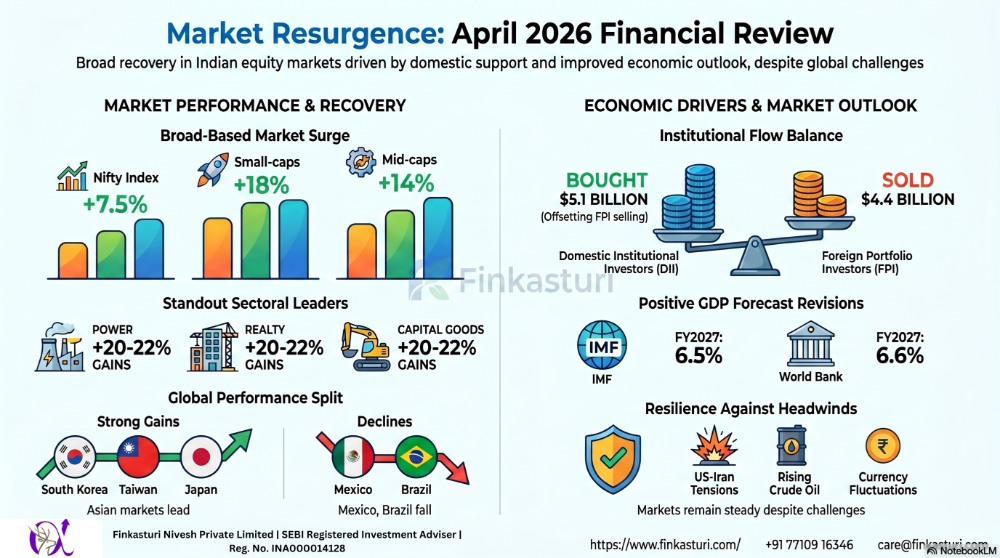
Indian equity markets ended the month on a strong positive note on the hopes of de-escalation in the West Asia conflict, recovering from the sharp sell-off in the previous month. The benchmark Nifty index surged by 7.5%. Broader markets outperformed the large-cap index, with mid-cap and small-cap indices climbing by 14% and 18%, respectively. As far as sectoral performance is concerned, all indices ended in the green, with Power, Realty, and Capital Goods emerging as the standout performers. Globally, most markets witnessed uptrend with heavy gains seen in Asian markets like South Korea, Taiwan, and Japan.
Investor sentiment remained resilient despite ongoing global uncertainty stemming from the US-Iran conflict, a depreciating rupee, and rising crude oil prices. Key macroeconomic developments included FY2027 GDP growth revisions for India, with the IMF and World Bank raising forecasts to 6.5% and 6.6%, respectively, while Moody's lowering its projection to 6%. Central banks maintained the status quo, as both the RBI and the US Federal Reserve kept their benchmark interest rates unchanged. On the domestic economic front, retail (CPI) and wholesale (WPI) inflation rose marginally, while industrial production (IIP) growth slipped. Other notable events included the IMD projecting a below-normal monsoon and early corporate earnings coming in largely in line with expectations. On the flows front, Foreign Portfolio Investors (FPIs) sold US$ 4.4 billion during April while Domestic Institutional Investors (DIIs) provided robust support by buying US$ 5.1 billion during the month.
Market Outlook: Looking ahead, Indian equity markets will likely continue to balance strong domestic momentum against external headwinds such as geopolitical tensions, rising crude oil prices, and currency fluctuations. The trajectory of domestic inflation and the potential impact of a below-normal monsoon will be key factors to monitor in the near term. An elongated conflict in West Asia remains a key risk for the markets going ahead. However, steady corporate earnings, inexpensive valuations and persistent support from domestic institutional investors provide a solid foundation for equity markets. These structural positives position the market well to navigate near-term macro volatility and sustain its recovery momentum over the medium term.
Happy Investing!
Get aware and build a strong foundation! Learn more today.
Investments in securities market are subject to market risks. Read all the related documents carefully before investing. This content is for general information and is not investment advice. Past market movements do not indicate future performance. Please consult your financial advisor.
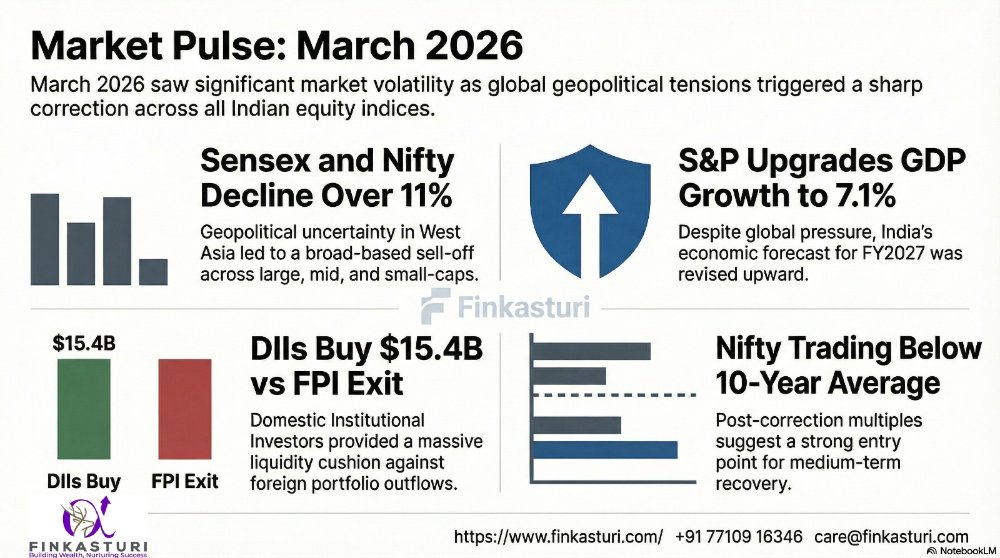
Indian equity markets ended the month with sharp losses, on the back of geopolitical uncertainty around the war in middle east. The benchmark indices declined significantly, with the Sensex and Nifty falling by 11.5% and 11.3%, respectively. Broader markets faced steep corrections, with mid-cap and small-cap indices declining 10.9% and 10.2%, respectively. As far as sectoral performance is concerned, Banks, Realty, and Auto emerged as the key laggards. Globally also markets saw heavy declines, led by sharp fall in South Korea, Indonesia, and Japan, highlighting broader global pressure during the month.
Investor sentiment was heavily dampened by escalating global uncertainty surrounding the West Asia conflict, which pushed Brent crude oil prices up sharply, alongside a depreciating rupee . However, key positive developments included proactive government measures, such as reducing excise duties on petrol and diesel and issuing a Natural Gas Control Order to prioritize supply. Among other events, S&P Global revised India’s FY2027 GDP growth forecast upwards to 7.1%, and IEA countries agreed to release 400 million barrels of emergency oil reserves. The US Federal Reserve kept the Federal Funds rate unchanged within the 3.5-3.75% range. On the flows front, Foreign Portfolio Investors (FPIs) sold US$ 12.1 billion, while Domestic Institutional Investors (DIIs) bought US$ 15.4 billion during the month.
Market Outlook: Looking ahead, Indian equity markets may navigate volatility stemming from ongoing geopolitical tensions in West Asia, sharp swings in crude oil prices, and currency fluctuations. However, proactive government interventions to manage fuel prices, steady GDP growth forecasts, and robust support from domestic institutional investors provide a strong foundation for the markets. Importantly, post the market correction, valuation multiples have come off significantly with Nifty50 Index trading below 10 year average multiples. The structural tailwinds, combined with potential for accelerating growth position the market well to absorb external shocks and support a potential recovery in sentiment over the medium term once tensions in West Asia subside.
Happy Investing! Get aware and build a strong foundation! Learn more today.
Investments in securities market are subject to market risks. Read all the related documents carefully before investing. This content is for general information and is not investment advice. Past market movements do not indicate future performance. Please consult your financial advisor.
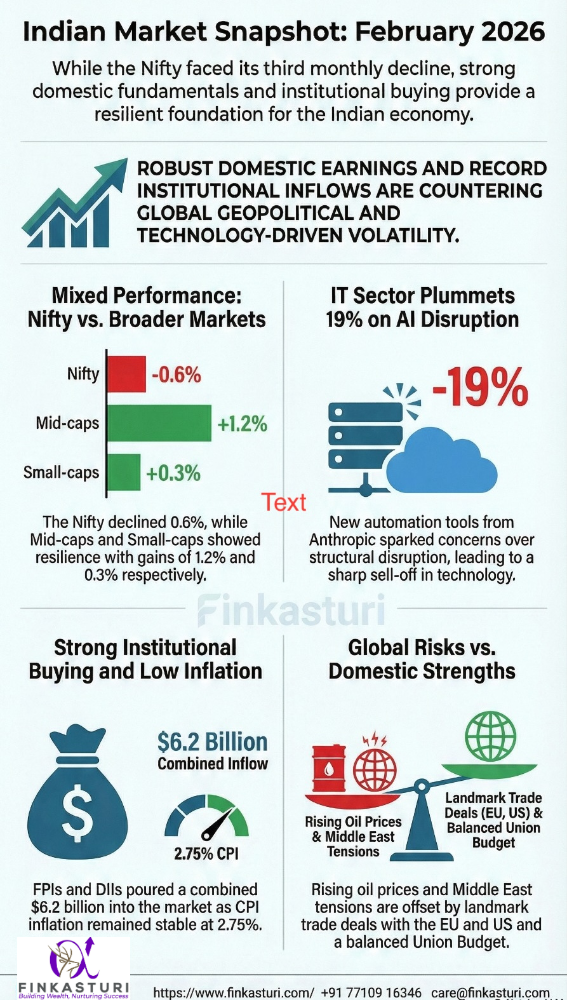
Indian equity markets recorded their third consecutive monthly decline, underperforming global peers. The Nifty index declined by 0.6%, while broader markets showed resilience, with the mid-cap and small-cap indices gaining 1.2% and 0.3%, respectively. Sectoral performance was largely positive, with Power, Consumer Durables, and Healthcare emerging as the top gainers, whereas the IT sector witnessed a sharp sell-off, declining 19% during the month. Globally, most markets ended positive, led by strong gains in South Korea, Thailand, and Taiwan.
Investor sentiment was dampened by rising geopolitical tensions between Iran and the US, as well as persistent concerns over AI-led disruption, which heavily impacted the IT sector following the unveiling of new automation tools by Anthropic. However, key positive developments included improving corporate earnings, with the Q3FY26 adjusted net income of Nifty50 index growing strongly. Additional tailwinds included the Indian rupee appreciating by 1.1%, alongside strong gains in gold and silver. On the macroeconomic front, the government targeted a fiscal deficit of 4.3% in the Union Budget for FY2027, while January CPI and WPI inflation stood at 2.75% and 1.8%, respectively. On the flows front, Foreign Portfolio Investors (FPIs) bought US$ 2 billion, while Domestic Institutional Investors (DIIs) bought US$ 4.2 billion in the secondary market during the month.
Market Outlook: Recent macro developments have been broadly positive for the Indian economy, highlighted by a balanced Union Budget FY2027, the successful conclusion of a key trade deal with the European Union alongside a landmark trade framework with the United States. Additionally, the US Supreme Court's ruling against reciprocal tariffs provides further relief for global trade dynamics. However, in the near term, Indian equity markets may navigate volatility stemming from ongoing geopolitical tensions in the Middle East and structural disruptions in the technology sector. Crude oil prices have gone up sharply due to war in the Middle East which doesn't augur well for India as we import the bulk of our crude oil consumption. A confluence of positive factors—such as robust corporate earnings growth, easing global trade tensions, stable domestic inflation, and steady institutional inflows from both FPIs and DIIs—provide a strong domestic foundation for Indian markets. These structural tailwinds position the broader market well for a resilient performance over the medium to long term.
Investments in securities market are subject to market risks. Read all the related documents carefully before investing. This content is for general information and is not investment advice. Past market movements do not indicate future performance. Please consult your financial advisor.
Thank You For Joining Our Session: Startups – Funding & Dynamics
· Category: Knowledge Series
Thank you for attending the 21st Investors’ Meet hosted by Finkasturi Nivesh on February 21. It was a pleasure having you with us as we explored the intricate landscape of "Startups – Funding & Dynamics".
We would like to extend our special thanks to our guest speaker, Dr. Kishore Nuthalapati, for sharing his 25 years of expertise and deep insights into the startup ecosystem. We hope the session provided you with actionable strategies for Building Wealth and Nurturing Success. As promised, please find the resources from the session below: • Session Recording: click here! (• Session Recording) (opens in new tab) • Feedback & Queries: Your input helps us improve. Please take a moment to share your feedback here: Open link (opens in new tab).
Investments in securities market are subject to market risks. Read all the related documents carefully before investing. This content is for general information and is not investment advice. Past market movements do not indicate future performance. Please consult your financial advisor.
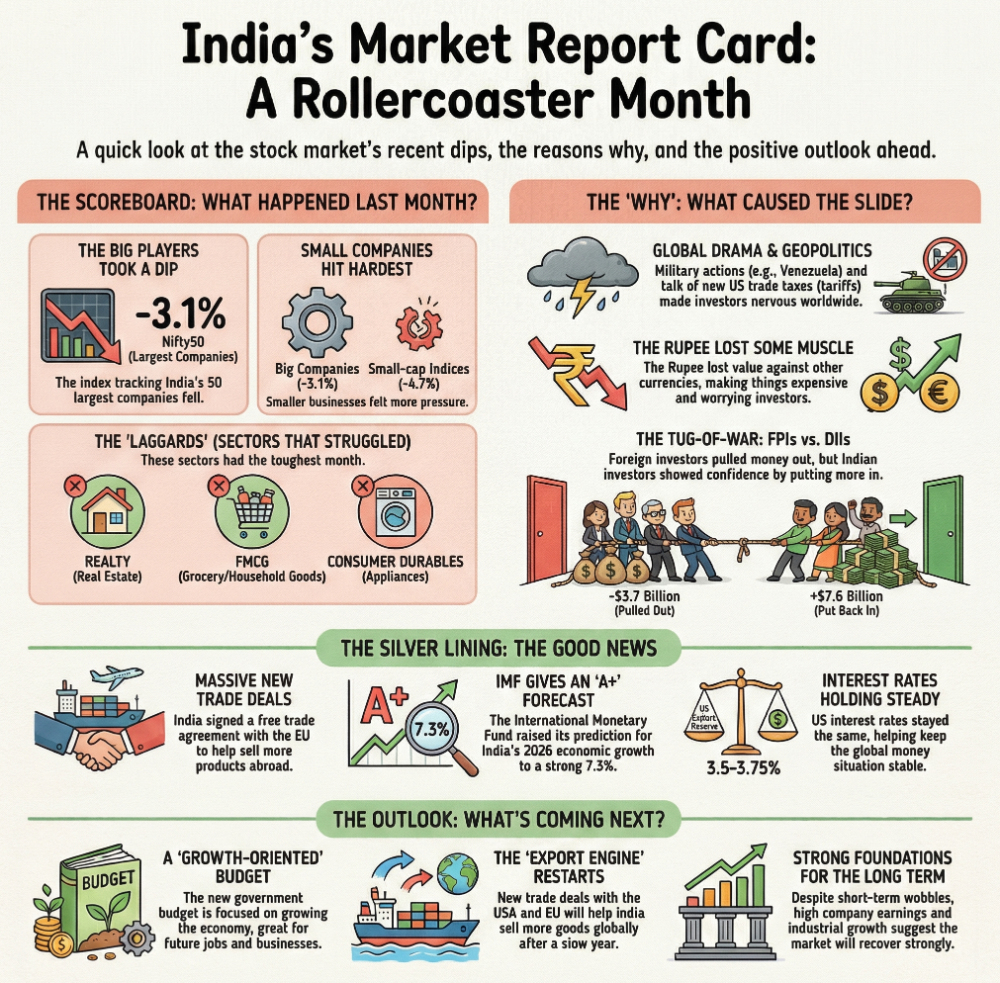
Indian equity markets ended the month with losses, underperforming global peers. The Nifty50 index declined by 3.1%, while broader markets faced steeper corrections, with mid-cap and small-cap indices falling 3.4% and 4.7%, respectively. Sectoral performance was largely negative, with Realty, FMCG, and Consumer Durables emerging as the key laggards. Globally, markets ended mixed, led by strong gains in South Korea, Brazil, and Taiwan, highlighting India’s relative underperformance during the month. Investor sentiment was dampened by escalating geopolitical tensions following US military action in Venezuela, renewed concerns over potential US tariffs, and a depreciating rupee. However, key positive developments included the conclusion of a free trade agreement between India and the European Union and the IMF revising India’s FY2026 GDP growth forecast upward to 7.3%. The US Federal Reserve kept the Federal Funds rate unchanged within the 3.5-3.75% range. On the flows front, Foreign Portfolio Investor (FPIs) sold US$ 3.7 billion, while Domestic Institutional Investors (DIIs) bought US$ 7.6 billion during the month.
Market Outlook: Early February has brought good news for Indian equity markets in terms of a growth oriented Union Budget and conclusion of India-USA trade deal. The back to back trade deal with the EU and USA should give significant impetus to India's export engine which has fallen behind over the last 1 year. In the near term, Indian equity markets may navigate volatility stemming from global geopolitical tensions and currency fluctuations. However, a confluence of positive factors such as trade agreements with large economies, upward revisions in GDP growth forecasts by the IMF/NSO, and better-than-expected corporate earnings provide a strong domestic foundation for Indian equity markets to move up. These structural tailwinds, combined with robust industrial growth, position the market well for a strong performance over the medium term.
Investments in securities market are subject to market risks. Read all the related documents carefully before investing. This content is for general information and is not investment advice. Past market movements do not indicate future performance. Please consult your financial advisor.
Future Ready: The Investor’s Guide To Budget 2026-27
· Category: Knowledge Series
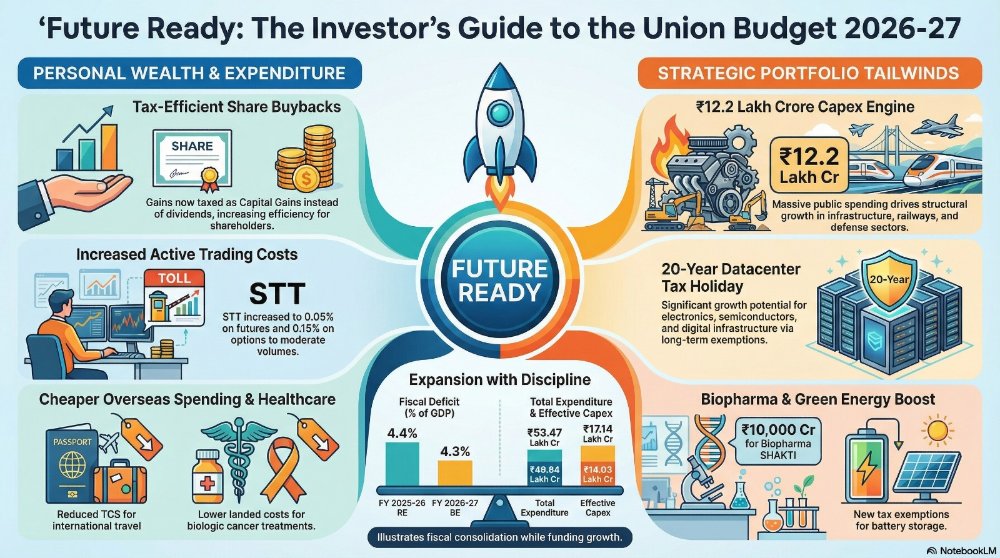
The Union Budget 2026-27, themed ‘Future Ready,’ focuses on maintaining fiscal discipline while driving growth through massive infrastructure investments and sectoral incentives.
For a long term investor, the budget offers a stable tax environment and specific tailwinds in manufacturing, healthcare, and infrastructure.
Below are the key budget items that directly impact your personal finances and your custom investment portfolio:
Your Wealth & Taxation * Tax-Efficient Buybacks: Gains from share buybacks will now be taxed as Capital Gains instead of dividends, improving tax efficiency for you as a shareholder. * Higher Trading Costs: The Securities Transaction Tax (STT) has increased to 0.05% on futures and 0.15% on options, which may moderate volumes and increase costs for active traders. Delivery based equity trades are not impacted. * Stable Income Tax: There are no changes to income tax slabs in either the Old or New Tax Regimes, providing predictability for your long-term financial planning.
Your Personal Expenses * Cheaper Overseas Spending: Tax Collected at Source (TCS) has been reduced for overseas education, medical treatments, and tours, making international travel and foreign studies more affordable. * Healthcare Savings: A focus on non-communicable diseases and increased accessibility to cancer therapies aims to lower the landed cost of biologic treatments.
Strategic Portfolio Tailwinds * Pharma & Biopharma: The Biopharma SHAKTI scheme (₹10,000 crore) and the addition of 100,000 allied health professionals are set to boost hospital utilization and service quality. * Manufacturing, Semiconductors & Datacenters: Continued commitment to the Production Linked Incentive (PLI) schemes and specific boosts for electronics and semiconductors offer strong growth potential for companies in these sectors. 20-year Tax holidays for data centre infrastructure * Infrastructure & Real Estate: The government is recycling CPSE assets through REITs and expanding cargo corridors, which provides new opportunities for income-generating infrastructure assets. * Power & Energy: Restructuring of PFC and REC Ltd. will enhance financing for power projects, while new exemptions for battery storage and solar glass support the green energy transition. * Metals (Steel Pipes): A significant budgetary increase for the Jal Jeevan Mission is expected to drive demand and benefit steel pipe manufacturers in your portfolio.
Closing Note With a massive ₹12.2 Lakh Cr Public Capex engine, the budget reinforces India’s structural growth story, making it an ideal time to focus on robust earnings growth within your custom portfolio. This " Future Ready" union budget will sustain India growth momentum, boost corporate earnings and make India one of the most preferred Investment destinations in Medium to long term.
Investments in securities market are subject to market risks. Read all the related documents carefully before investing. This content is for general information and is not investment advice. Past market movements do not indicate future performance. Please consult your financial advisor.
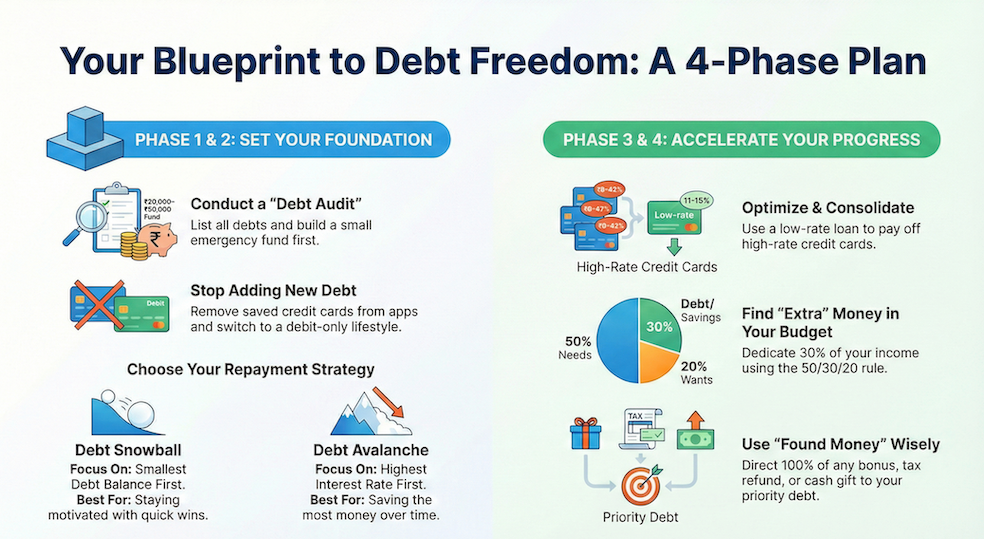
Feeling overwhelmed by debt is a common experience, but it doesn't have to be a permanent one. The journey to financial freedom can feel daunting, but it becomes achievable when broken down into manageable steps. This email is your roadmap, a clear, four-phase action plan that will guide you from understanding your debt to actively eliminating it. Let's take the first step together.
Before you can start paying down debt effectively, you need to understand the full picture and prepare for the journey ahead. This phase is about gaining clarity and creating the stability needed for long-term success.
1. List Every Debt The first step to gaining control is to know exactly what you're facing. Create a comprehensive list of every single loan and credit card balance you have. This exercise removes uncertainty and transforms a vague sense of worry into a concrete list you can manage.
2. Establish a Safety Net It may seem counterintuitive, but before aggressively paying down debt, you must set up a small emergency fund of ₹20,000–₹50,000. This isn't a delay; it's essential insurance. When an unexpected expense like a car repair or medical bill arises, this fund will prevent you from having to take on new debt, ensuring your progress isn't derailed.
3. Stop the Bleeding You cannot get out of a hole while you are still digging. Make a firm commitment to not adding any new debt to your name while you are in repayment mode. Two immediate actions can help enforce this rule:
Delete all saved credit card information from online shopping sites and apps.
Switch to a debit-card-only lifestyle for your daily spending.
Phase 2: Choose Your Repayment Strategy
There are two proven methods for tackling multiple debts. The "best" one is not about complicated math; it's about choosing the strategy that best fits your psychology and keeps you motivated for the long haul.
1. Debt Snowball (For Motivation)
How It Works: Pay the minimum amount on all of your debts. Then, direct every extra rupee you have toward the debt with the smallest total balance first, regardless of its interest rate.
Primary Benefit: You get a quick psychological win when your first, smallest debt is paid off. This builds momentum and motivation, making you more likely to stick with the plan.
2. Debt Avalanche (For Math)
How It Works: Pay the minimum amount on all of your debts. Then, direct every extra rupee you have toward the debt with the highest interest rate first, regardless of its balance.
Primary Benefit: You pay the least amount of total interest over the life of your loans. This method saves you the most money in the long run.
There is no wrong answer here. The most effective plan is the one you will consistently follow. Choose the strategy that you believe will keep you the most engaged and motivated. Once you have selected a strategy and put it into motion, you can explore ways to make your payments work even harder for you.
Phase 3: Accelerate Your Progress (Lower Your Interest & Pay Less)
With your repayment plan active, the next step is to find ways to reduce the amount of interest you're paying. Lowering your interest costs means more of your money goes directly toward paying down the principal balance, speeding up your journey significantly.
1. Debt Consolidation If you are juggling multiple high-interest debts, such as credit cards with rates of 36-42%, debt consolidation can be a powerful tool. The goal is to take out a single personal loan at a much lower interest rate (e.g., 11-15%) and use it to pay off all your other debts at once. This simplifies your finances into one monthly payment and can save you a substantial amount of money on interest
2. Loan Against Mutual Funds (LAMF) If you can pay off credit card debt using loan amount collateralized to your mutual fund scheme, it is a sophisticated debt optimization strategy. It leverages your existing assets to swap high-interest debt (typically 36%–45% APR) for a low-interest secured LAMF loan (typically 9%–12% APR). The benefit is your investments remain in the market, continuing to earn compound interest and dividends while acting as collateral.
3. Balance Transfer This is a tactic for tackling high-interest credit card debt. Look for credit cards that offer a 0% introductory interest rate on balance transfers for a promotional period, often 6-12 months. By moving your high-interest balance to this new card, you get a temporary "grace period" where interest stops accumulating. During this time, every rupee you pay goes directly to reducing the principal. Be aware: This is a temporary strategy. Have a plan to pay off the balance before the promotional period ends, as the interest rate will typically jump to a very high level afterward.
4. Bank Negotiation If you are genuinely struggling and have a history of consistent payments, being proactive with your bank can open up options. Call your bank's recovery or hardship department and explain your situation. Based on your repayment history, you can ask for one of two outcomes:
Interest Rate Reduction: A permanent or temporary lowering of your interest rate.
Moratorium: A temporary pause on payments to give you time to get back on your feet.
Phase 4: Find the Cash to Fuel Your Plan
A debt repayment strategy requires fuel, and that fuel is extra cash. By making intentional adjustments to your finances, you can free up more money to direct toward your priority debt each month.
1. Adjust Your Budget: The 50/30/20 rule is a popular budgeting framework. To supercharge your debt repayment, consider adjusting it temporarily. Aim to allocate 50% of your income to needs (housing, food), 20% to wants (entertainment), and a powerful 30% toward debt & savings.
2. Use "Found Money." Wisely: Create a simple rule for any unexpected income you receive. 100% of "found money"—like a work bonus, a tax refund, or a cash gift—should be immediately directed toward your priority debt according to the Snowball or Avalanche method you chose.
3. Generate Micro-Earnings: The modern gig economy offers flexible ways to earn extra income. Consider these options and commit the earnings solely to your debt repayment plan:
Sell unused items (clothes, electronics, furniture) on re-commerce platforms.
Take on 2-3 hours of freelance work per week in a field you're skilled in.
Investments in securities market are subject to market risks. Read all the related documents carefully before investing. This content is for general information and is not investment advice. Past market movements do not indicate future performance. Please consult your financial advisor.
Ready to start your investment journey? The market offers diverse options!
"Feeling confused about where to start with investing? 🤔 You're not alone! It can seem super complicated, but once you break it down, it's totally manageable. Think of your money as seeds you plant, you want to choose the right garden and the right kind of seeds so they can grow over time!
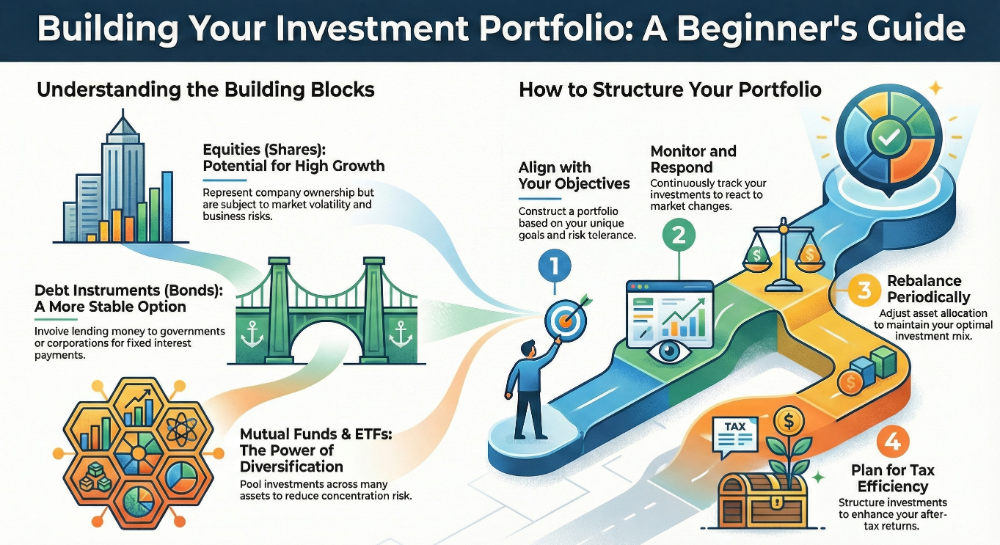
📈 Equities (Shares): Potential for growth, but subject to market changes. 🤝 Debt Instruments (Bonds): Stability with fixed interest payments. 🛡️ Mutual Funds & ETFs: Diversification and professional management to align with your goals.
We’re talking about the fundamental building blocks of investing: 1. Stocks (Equities): Imagine buying a tiny piece of your favorite company that's a share. If the company does well, your share usually goes up in value, and sometimes they give out dividends (a cash bonus). The upside? Great growth potential The catch? They can be a bit of a rollercoaster ride (market volatility).
2. Bonds (Debt Instruments): Think of yourself as a bank lending money to a government or a big corporation. They promise to pay you back with interest along the way. These are generally seen as steadier and less dramatic than stocks, offering more stability. Perfect if you’re looking for something reliable
3. Mutual Funds & ETFs: If picking individual stocks or bonds sounds like too much work, these are your best friends. They bundle up investments it's like having a professionally managed mixed bag of stocks, bonds, and other assets. This instant diversification helps spread out the risk, so you aren't putting all your eggs in one basket.
Getting familiar with these core instruments Equities, bonds, and Funds is the first, most important step toward building a solid financial future. Ready to learn more and turn that confusion into confidence? Stay tuned we’ve got more easy-to-understand tips coming your way!
Get aware of your options and build a strong foundation! Learn more today.
Investments in securities market are subject to market risks. Read all the related documents carefully before investing. This content is for general information and is not investment advice. Past market movements do not indicate future performance. Please consult your financial advisor.
Indian equity markets ended the month with modest losses, underperforming global peers. The Nifty Index declined by 0.3%, while broader markets were weak, with mid-cap and small-cap indices falling 0.9% and 0.6%, respectively. Sectoral performance was mixed, with metals, oil & gas, and auto stocks outperforming, whereas capital goods, consumer durables, and realty stocks were the key laggards. Globally, markets ended largely positive, led by strong gains in South Korea, Taiwan, and Malaysia, highlighting India’s relative underperformance during the month.
Investor sentiment was shaped by a series of global and domestic policy actions. The RBI cut the policy repo rate by 25 bps to 5.25% while maintaining a neutral stance, while the US Federal Reserve delivered its third 25 bps cut of the year. In contrast, the Bank of Japan raised rates by 25 bps to 0.75%, the highest level since 1995. On the flows front, FIIs sold USD 2.6 billion, while DIIs bought USD 8.1 billion during the month.
On the macroeconomic front, inflation remained benign but edged up marginally, with CPI inflation rising to 0.71% in November from 0.25% in October, while WPI inflation stayed in deflation at (-)0.3% yoy. Industrial activity was robust, with IIP growth accelerating to 6.7% in November 2025, marking a 25-month high.
Market Outlook:
Looking ahead, Indian equity markets may continue to experience selective volatility amid mixed global cues and uncertainty around signing of trade deal with USA. However, supportive domestic fundamentals, lower policy rates, strong industrial growth, benign inflation, and sustained domestic institutional flows should help limit downside risks in the markets. Also, policy reforms such as GST rationalization, improving growth visibility on GDP and earnings remain key tailwinds, positioning the market well for a gradual improvement in sentiment over the medium term.
Happy Investing!
Investments in securities market are subject to market risks. Read all the related documents carefully before investing. This content is for general information and is not investment advice. Past market movements do not indicate future performance. Please consult your financial advisor.